Pickleball Shoes vs Tennis Shoes: Which Court Shoe Should You Choose?
Pickleball shoes vs tennis shoes explained by movement, traction, fit, and grip socks. Choose the right court setup, then shop Dillz.
On this page
Pickleball shoes and tennis shoes can both work on the pickleball court. The better choice depends on lateral stability, fit, outsole design, durability, and the surface you play on, rather than the sport printed on the box. When comparing pickleball shoes vs tennis shoes, focus first on how the shoe handles court movement, then consider whether grip socks can improve the feel inside a properly fitted pair.
Pickleball Shoes vs Tennis Shoes: Is There a Real Difference?
The categories overlap more than many buyers expect. Both are court shoes designed for side-to-side movement, quick stops, lunges, and changes of direction. A well-fitting tennis court shoe can be a practical pickleball choice, especially for players who regularly play both sports.
Pickleball is the primary use case here because its smaller court creates frequent short adjustments around the kitchen line, baseline, and sidelines. The official pickleball court measures 20 by 44 feet for both singles and doubles, according to the 2026 USA Pickleball Official Rulebook. Tennis uses a 78-foot court, with widths of 27 feet for singles and 36 feet for doubles under the ITF Rules of Tennis hosted by USTA.
Those dimensions influence movement, but they do not determine shoe performance on their own. A player’s position, pace, court surface, and shoe model matter more than the label.
Dillz bias note: Dillz is pickleball-first, so this comparison gives extra attention to pickleball movement and in-shoe comfort. Tennis shoes remain a strong choice for players who split time between both sports.
How Movement Patterns Change the Better Shoe Choice
Pickleball often feels like a sequence of short lunges, pivots, squats, split steps, and lateral resets. Tennis usually demands more court coverage, acceleration, deceleration, and, depending on the surface and style of play, controlled sliding. Foot Doctor Zach describes pickleball movement as more angular and multi-directional, while tennis more often involves traveling across a longer court in “Pickleball Vs Tennis Shoes: What’s Important (And What’s Not)”.
The distinction is useful, but it is not absolute. A doubles tennis player near the net may move similarly to a pickleball player, while an aggressive pickleball player may make hard baseline movements. Evaluate the shoe itself for:
- Side-to-side stability that keeps the foot supported during lateral cuts.
- A secure heel counter that limits heel lift.
- A supportive midfoot and reliable lacing system.
- A reinforced toe for lunges and repeated stops.
- Enough forefoot flexibility to move naturally without allowing the foot to roll inside the shoe.
Choose a pickleball-oriented court shoe when quick resets, a lighter feel, and close-in movement are your priorities. Choose a tennis shoe when one pair must handle both sports or when longer-court acceleration and durability matter more. A good tennis court shoe can serve pickleball well when its fit and outsole suit the court.
Court Surface, Outsole Traction, and Durability
The wrong default is choosing by sport name alone, then assuming more grip will solve every sliding problem. The better workflow is to check the facility and court surface first, inspect the shoe’s outsole, and evaluate lateral support before considering socks.
Running and walking shoes deserve separate caution. As Dr. Dave Candy explains in “Pickleball Shoes vs. Tennis Shoes: What’s the Difference?”, racket-sport footwear should be designed for court movement. Courtside After Hours also notes that running and walking shoes can lack the lateral support and court-appropriate tread needed for repeated side-to-side movement in “What Is The Difference Between Tennis & Pickleball Shoes?”.
Indoor and outdoor courts create different outsole priorities. Pickleball Warehouse’s court-shoe guidance recommends matching the shoe to the playing surface because indoor floors and outdoor hard courts place different demands on rubber, traction, and abrasion resistance. An indoor outsole may feel too sticky or wear quickly outdoors, while an outdoor outsole may provide poor traction on wood or laminate.
That makes durability a real tradeoff. A lighter pickleball outsole can suit players who mainly play pickleball. A durable tennis court shoe may be the better fit for players who alternate between tennis and pickleball, especially when tennis sessions involve repeated acceleration, deceleration, or sliding.
Fit Inside the Shoe: Where Grip Socks Add a Separate Advantage
Shoe-to-court traction and foot-to-shoe movement are two different interfaces. The outsole controls contact with the floor. A grip sock addresses unwanted movement between the foot, sock, and shoe after the shoe already fits correctly.
| Decision area | Pickleball shoe | Tennis shoe | What decides it for you |
|---|---|---|---|
| Movement pattern | Short pivots, lunges, resets, and lateral repositioning | Longer coverage, acceleration, deceleration, and possible sliding | Pickleball-first movement favors a lighter court feel; mixed use favors versatility |
| Typical fit | Often close and supportive through the midfoot | May offer more forefoot room, depending on the model | Choose the shape that holds the heel and midfoot without crowding the toes |
| Lateral stability | Essential for kitchen-line movement and quick cuts | Essential for baseline movement and recovery steps | Reject any shoe that lets the foot roll or lift inside |
| Outsole considerations | Match indoor or outdoor pickleball conditions | Match the tennis surface and any shared facilities | Facility rules and surface compatibility come before sock grip |
| Durability | Can suit frequent pickleball use when the outsole matches the court | Often useful for players sharing time between sports | Pick the more durable model when tennis creates heavier wear |
| Best use case | Players focused mainly on pickleball | Players who regularly play tennis and pickleball | Let your weekly court mix decide |
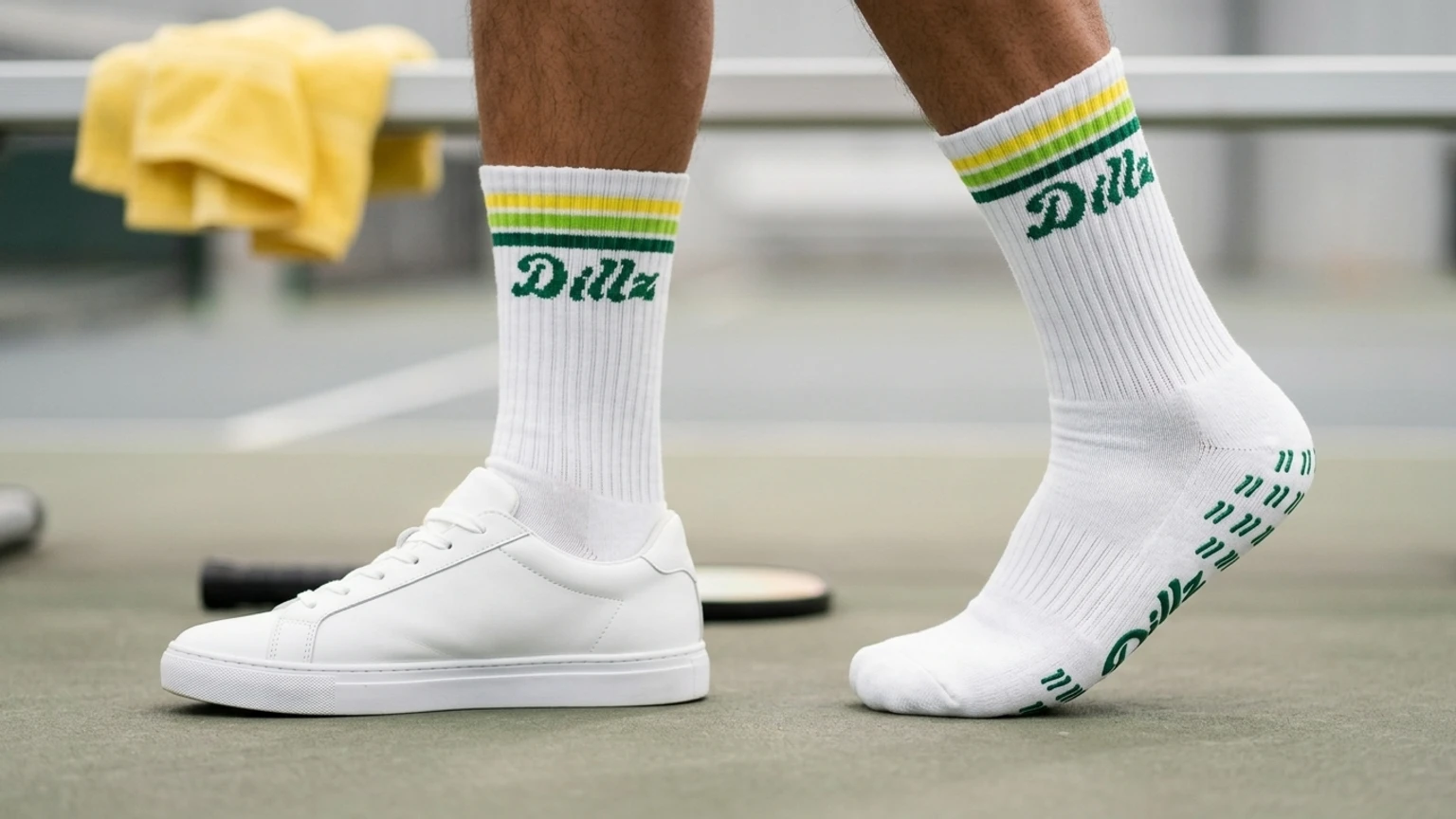
Dillz Grippy Grippy™ Crew and Grippy Grippy™ Ankle use full-sole DillzGrip, breathable DillzAir fabric, and ArchHug support. The Crew provides higher coverage, while the Ankle offers a lower-cut fit. Dillz presents both as options for reducing unwanted movement inside a well-fitting court shoe. The 2022 grip-sock study indexed by PubMed supports investigating this mechanism because it examined in-shoe forefoot displacement and change-of-direction performance in team-sport participants. It did not test Dillz, pickleball players, or either specific shoe model.
For players 30 and older who play recreationally or in leagues, check breathable construction, a secure heel, targeted arch support, and enough toe room. If the shoe is too large, lacks lateral support, has a worn or unsuitable outsole, or violates an indoor-court rule, correct the footwear first. A grip sock cannot repair those problems.
Players dealing with hot spots can also review anti-blister court socks, while those on indoor courts may benefit from guidance on non-skid socks for indoor pickleball. For a broader look at in-shoe traction, see what grip actually does inside a pickleball shoe. Players who prefer lower coverage can compare ankle grip sock options, and anyone rebuilding a court kit can use this court-sock buying checklist.
View this post on Instagram
Who Should Choose Each Shoe?
Choose a pickleball shoe if pickleball is your primary sport, your movement is concentrated around short lateral resets, and you prefer a lighter court feel. A model such as the K-Swiss Express Light Pickleball is described by K-Swiss as lightweight and breathable, with a K-EVA midsole and plantar support on the selected product listing. That description supports evaluating the model, but it does not prove that every pickleball-labeled shoe performs better.
Choose a tennis shoe if you regularly play both sports, need more long-court versatility, or place a higher priority on established outsole durability. The K-Swiss Hypercourt Express 2, for example, is listed as a light, breathable tennis shoe with a rubber outsole and Ortholite x40 sock liner on the selected product page. Fit and surface compatibility still decide whether it suits your court.
Neither category fits when the shoe is built for walking or running rather than court movement, the outsole conflicts with the playing surface, or the foot moves excessively inside the shoe. In that situation, replace or refit the shoe before adding a sock.
Key Takeaways
- A suitable tennis court shoe can work for pickleball when the fit, lateral support, outsole, and surface match.
- Pickleball shoes favor close-in movement, while tennis shoes can offer a practical mixed-sport option.
- Court-to-outsole traction and sock-to-foot stability are separate decisions.
- Grip socks are an optional in-shoe comfort measure, not a substitute for correct footwear.
Players who already have an appropriate court shoe and want a more settled feel during quick stops can explore Dillz Grippy Grippy™ Crew or Ankle. Find the Grippy Grippy™ pair for your game. Shop grip socks.
Frequently Asked Questions
Can I wear tennis shoes to play pickleball?
Yes. A well-fitting tennis court shoe can work for pickleball when its outsole suits the actual surface and it provides reliable lateral support. Pickleball shoes vs tennis shoes is a model-by-model decision, not a rule that one label always wins.
Do pickleball shoes really make a difference?
They can, when the specific model fits your foot and matches your court. The useful differences involve stability, weight, cushioning, outsole behavior, and durability, rather than the pickleball label alone.
Are pickleball shoes ok for walking?
Short walking between courts may be practical if the shoes feel comfortable and stable. These court shoes are designed for court movement, so the available evidence does not establish that any particular pickleball model is suitable for prolonged walking.
What type of shoes should I use for pickleball?
Use facility-approved court shoes with a surface-appropriate outsole, secure heel and midfoot support, enough toe room, and lateral stability. After the shoe fits correctly, consider grip socks separately if your foot or sock still moves inside during play.