Pickleball Equipment: Build a Complete Setup for Confident Court Movement
Build better pickleball equipment around court shoes, socks, paddles, and balls. Use this guide to choose a comfortable setup for every session.
On this page
- Pickleball equipment starts with a complete court system
- Build the minimum setup: paddle, ball, and court shoes
- How should you choose a paddle and ball for the way you play?
- Court-shoe traction and sock grip solve different problems
- What to look for inside a pickleball grip sock
- When a three-pack is worth adding to your gear bag
- Key Takeaways
- Frequently Asked Questions
Pickleball equipment starts with five practical pieces: a paddle, the right ball, court shoes, comfortable apparel, and movement-support accessories. The paddle affects how you play, while shoes and socks affect how settled you feel during split steps, stops, and lateral movement. For recreational and league players, the strongest setup grows in stages instead of forcing every accessory into the first purchase.
Pickleball equipment starts with a complete court system
Most players begin with the paddle because it is the most visible part of the setup. That is also where many buyers stop. A better approach treats the court system as a connected group of choices:
- Paddle: Choose for grip fit, comfort, weight, control, and playing style.
- Ball: Match the ball to the court surface, especially when switching between indoor and outdoor play.
- Court shoes: Look for lateral support, a low-to-the-ground profile, and a non-marking sole. Pickleball Central’s shoe guidance identifies these as core court-shoe priorities.
- Apparel: Wear clothing that allows repeated reaching, bending, and rotation without distraction.
- Movement accessories: Add socks, towels, hats, or other items when they solve a specific comfort or movement problem.
The wrong default is buying a premium paddle first and treating footwear as an afterthought. A paddle can improve feel and control, but an unstable shoe or uncomfortable sock can make every stop feel uncertain. Players who compete recreationally or in leagues several times a month usually benefit from building the setup around repeated movement, comfort, and durability.
That does not mean buying everything at once. Start with the equipment needed to play, then add accessories when a clear issue appears, such as foot movement inside the shoe, rubbing, poor breathability, or a laundry gap between sessions.
Build the minimum setup: paddle, ball, and court shoes
A new or returning player can usually begin with a paddle, a compatible ball, and court shoes. A bag, cart, portable net, paddle cleaner, training tool, or extra accessories can wait until the player knows how often and where they will play. Pickleball Central’s starter equipment guide also lists the paddle, ball, and court shoes as the essential foundation.
Paddle price should follow commitment and need. In Pickleball Warehouse’s equipment video, the practical point is that a higher price can reflect construction and expected durability rather than making the paddle automatically easier to use. Someone testing the sport can choose an entry-level paddle with a comfortable grip. A frequent player may value a construction that holds up to regular use, but that decision should come after identifying preferred weight, balance, and control.
Court shoes belong in the minimum setup because pickleball asks the player to stop, recover, pivot, and move laterally. Running shoes are designed around forward movement and cushioning. They can feel soft while offering less structure for repeated court angles.
A court shoe typically uses a supportive heel counter and shank to help the foot stay upright during twisting and angled movement. It should also have a sole intended for court use. The practical check is simple: if the shoe feels loose when the player shuffles side to side, it is not ready for repeated pickleball movement.
How should you choose a paddle and ball for the way you play?
A useful paddle decision starts with the player, not a generic ranking. Use this framework before comparing models:
| Decision factor | What to check | When it matters most |
|---|---|---|
| Grip fit | Can the player hold the handle without squeezing hard? | Choose comfort first if hand fatigue appears quickly. |
| Weight and balance | Does the paddle feel easy to position during resets and volleys? | Prioritize a manageable feel for recreational play or a return after time away. |
| Control or power | Does the player need softer placement or more force behind drives? | Match the choice to current technique rather than buying for a future style. |
| Frequency of play | Will the paddle see occasional sessions or regular league use? | Higher construction quality becomes more relevant as use becomes more frequent. |
The ball decision depends on the playing surface and conditions. “Indoor” primarily refers to a smoother gym or recreation-center floor, not simply whether the court has a roof. “Outdoor” generally refers to a rougher surface that places different demands on the ball. Franklin’s ball range describes the X-26 indoor ball as designed for gym floors and recreation-center courts, while the Franklin X-40 Outdoor Pickleball is listed as USA Pickleball approved and associated with the US Open Pickleball Championships.
Franklin X40 can be a useful named example for outdoor players, but it is not a universal recommendation. Check its current specifications and availability before publishing or purchasing. Players who regularly switch between gym floors and outdoor courts may need more than one ball type.
Court-shoe traction and sock grip solve different problems
Shoe traction and sock grip operate at different points in the movement chain.
The shoe outsole interacts with the court. Its job is to provide appropriate contact with the playing surface during shuffles, pivots, and stops. A court shoe’s structure also helps support the foot during lateral movement. This is why a cushioned running shoe can feel comfortable while still being a poor match for repeated pickleball angles.
Sock grip works inside the shoe. It addresses unwanted movement between the foot, sock, and shoe when the court shoe already fits properly. A grippy sock can help the player feel more settled during split steps and direction changes, but it does not provide the outsole traction, structure, or stability of a court shoe.
The manual workflow is straightforward:
- Confirm that the court shoe fits securely at the heel and midfoot.
- Check whether the foot slides forward, the sock bunches, or the heel lifts during movement.
- Replace an unsuitable shoe before adding an accessory.
- If the shoe fits well but the in-shoe feel remains unsettled, test a grip sock.
- Stop using the setup if it creates pressure, numbness, rubbing, or restricted movement.
This distinction also explains why non-slip socks for pickleball should be evaluated as an in-shoe accessory. They are part of movement comfort, not a substitute for proper court footwear.
View this post on Instagram
What to look for inside a pickleball grip sock
A pickleball grip sock should pass five checks:
- Full-sole grip: Traction should cover the contact areas that matter during stops and lateral movement.
- Targeted arch support: The sock should feel secure through the midfoot without creating pressure.
- Breathable construction: Repeated play makes moisture management a comfort priority.
- Comfortable fit: The sock should stay smooth, with no bunching at the toes or heel.
- Court-shoe compatibility: It should fit inside a properly sized shoe without making the shoe tight.
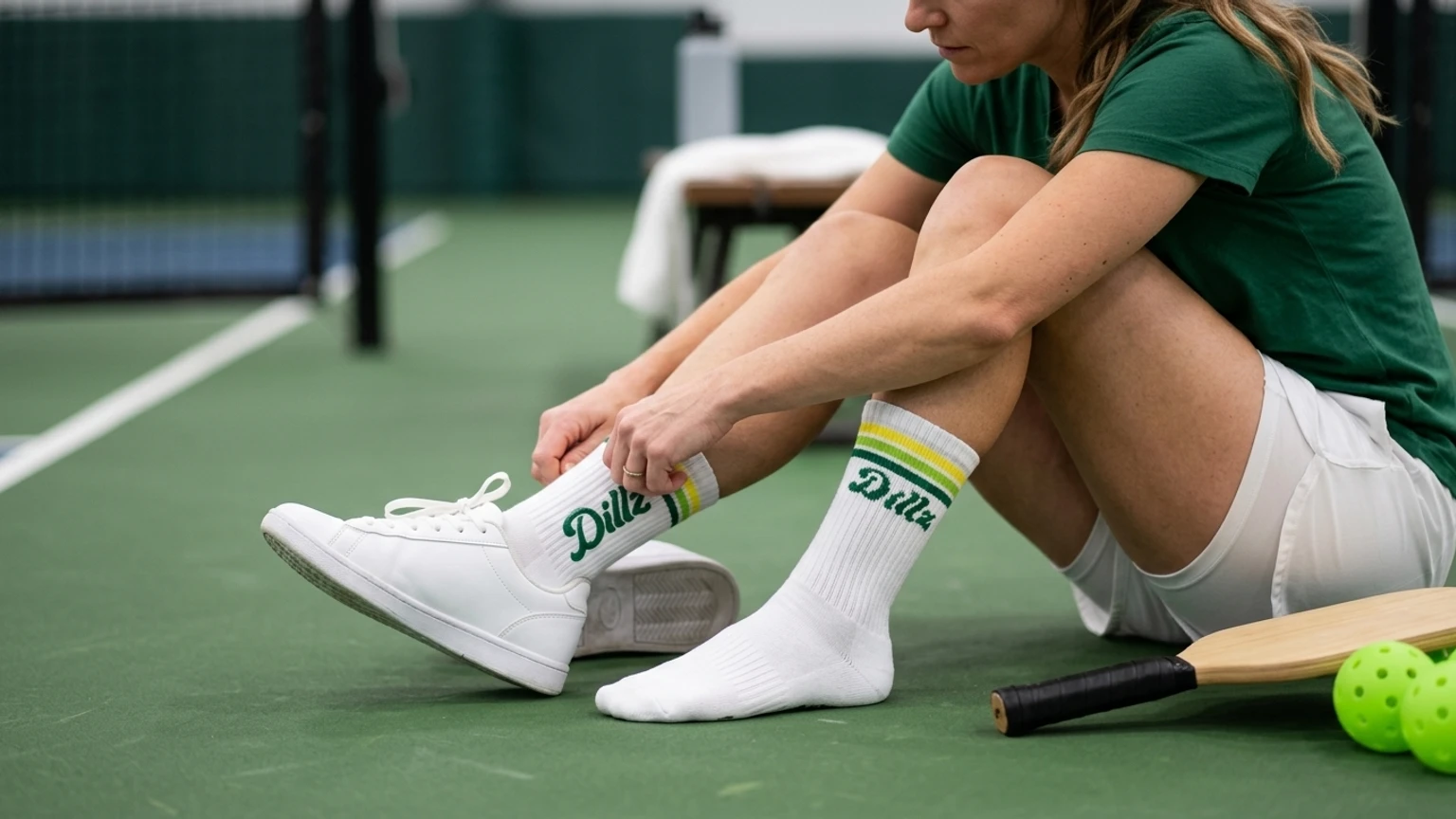
Dillz Grippy Grippy™ Crew and Ankle socks fit this pickleball-first use case by pairing full-sole grip with breathable comfort, targeted arch support, and coastal court style. The Crew style is built around quick cuts, split steps, kitchen resets, drives, and long rallies. Core Crew and Ankle styles include S/M and L/XL variants, giving players a basic fit decision before they compare height.
The comparison question is not which brand has the loudest claim. It is which design matches the player’s court use. Tavi Tec emphasizes double-grip traction for cutting and direction changes. Pointe Studio grip socks emphasize full-foot grip for Pilates, barre, and yoga. Squidsocks.ink pickleball socks use S-GRIP™ zones in a pickleball-specific offering. Buyers comparing Dillz with Tavi, Pointe Studio, OS1st, or squidsocks.ink should check full-sole coverage, arch feel, breathability, height, and how the sock fits their existing court shoe.
Players who struggle with rubbing should also review anti-blister socks for pickleball, while those deciding between heights can compare ankle grip socks for court shoes.
When a three-pack is worth adding to your gear bag
A three-pack makes practical sense when the player’s schedule creates a rotation problem. Someone who plays several times a month may prefer one pair for the next session, one pair in the laundry, and one clean backup. The same logic applies to players who move between pickleball, tennis, padel, baseball, and flag football. The common need is a comfortable sock that stays stable inside well-fitting athletic footwear during repeated movement.
Use this purchase rule:
| Your situation | Three-pack decision | Reason |
|---|---|---|
| Occasional play and reliable existing socks | Wait | A new pack solves little if current socks remain comfortable and stable. |
| Several sessions each month | Consider it | Rotation reduces the need to wash and dry the same pair immediately. |
| League play or back-to-back court days | Strong fit | A clean backup becomes useful when sessions are close together. |
| Pickleball plus other active sports | Strong fit | The socks can serve multiple movement-focused footwear setups. |
Laundry routine matters as much as play frequency. If socks are washed after every session and dry quickly, a single pair may be enough. If laundry is delayed, the player travels for matches, or current socks develop rubbing and bunching, a rotation has a clearer purpose.
Dillz offers Grippy Grippy™ Crew and Ankle options for players who want the same pickleball-first principles across court and field activities. The stop condition is equally important: if existing socks stay comfortable, dry well, and remain stable inside the shoe, a three-pack is optional rather than necessary.
Key Takeaways
- Build around a paddle, ball, court shoes, comfortable apparel, and only the accessories that solve a real problem.
- Choose court shoes for lateral support and court traction, then consider grip socks for movement inside a well-fitting shoe.
- Pick balls by playing surface, not simply by whether the court is covered.
- A three-pack earns its place when play frequency, laundry timing, or multi-sport use creates a rotation need.
For players who have already solved the shoe fit question and want a more settled feel during stops, resets, and lateral movement, Dillz Grippy Grippy™ socks provide a pickleball-first option with full-sole grip, targeted arch support, breathable comfort, and Crew or Ankle styling. Find the Grippy Grippy™ pair for your game. Shop grip socks.
Frequently Asked Questions
What equipment is needed for pickleball?
The essential pickleball equipment is a paddle, a compatible ball, and court shoes. Comfortable apparel is useful, while bags, carts, nets, cleaners, training tools, and grip socks can be added when a specific need appears.
What is the 10 second rule in pickleball?
The 10 second rule is a pacing guideline that limits serve and return preparation to ten seconds, according to Pickleball Central’s explanation. It helps keep play moving between points.
Is pickleball harder on the body than tennis?
Pickleball is generally considered lower impact than tennis because the court is smaller and players cover less distance, as described in Pickleball.com’s shoe guidance. Court shoes still matter because pickleball includes repeated stops, pivots, and lateral movement.
What is replacing pickleball?
No single sport has replaced pickleball. Paddle tennis and platform tennis are being positioned as alternatives in some markets, but the better choice depends on the player’s preferred court size, equipment, pace, and community. The same movement principles still apply across these sports: stable footwear, a secure fit, and equipment matched to the playing surface.