Non Slip Socks for Pickleball: What Grip Actually Does Inside Your Shoe
Learn what non slip socks do inside pickleball shoes, how to choose grip, and when court socks are worth buying.
On this page
Non slip socks can reduce unwanted movement between your foot, sock, and shoe during pickleball, especially during split steps, lateral shuffles, and quick bursts toward the kitchen line. They do not create shoe-to-court traction, repair a poor fit, or guarantee fewer falls. Their value depends on the sock’s grip placement, fit, breathability, and the condition of the court shoe.
What non slip socks do inside a pickleball shoe
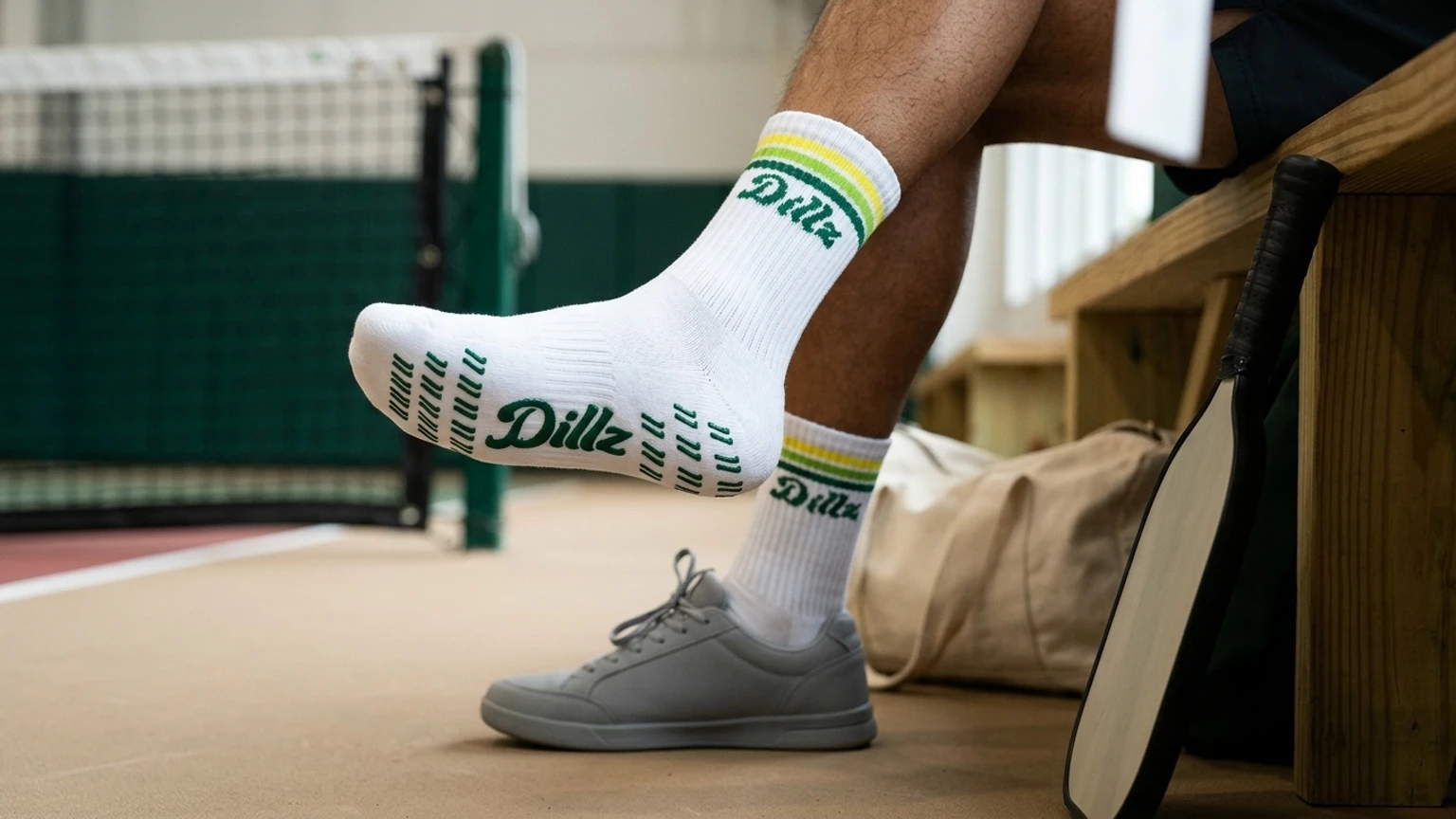
A pickleball grip sock works at the interface between your foot and the inside of your shoe. Full-sole grip can help the sock stay more settled against the insole, while a close fit limits bunching around the toes and heel. Breathable fabric helps manage heat, and targeted arch support can make the sock feel more secure during repeated starts and stops.
That combination matters during common pickleball movements. A player may notice unwanted shifting during a split step, a lateral shuffle, a short sprint to the kitchen line, or a recovery step after reaching wide for a ball. In each case, the goal is a more settled foot inside a properly fitted court shoe.
A 2022 sport experiment found faster performance in a 26-meter slalom when players wore grip socks instead of regular socks. The same study measured nearly twice the grip at the sock-to-insole interface, while finding no difference in the shoe-to-floor friction used during cutting and turning. The result supports a useful distinction: grip socks can affect movement inside the shoe, while the outsole controls contact with the court. Grip socks improve slalom performance and reduce in-shoe foot displacement, 2022
The same inside-shoe benefit can apply to tennis, where split steps, baseline recovery, and lateral court coverage also place repeated demands on the foot and sock.
Grip inside the shoe is different from traction on the court
Think of pickleball footwear as four separate interfaces:
| Interface | What manages it | What to check | What not to infer |
|---|---|---|---|
| Foot to sock | Sock fit and fabric | Secure heel, smooth toe area, no bunching | A tight sock automatically fixes every fit issue |
| Sock to insole | Grip coverage and shoe fit | Full-sole or targeted grip, sock thickness | More grip guarantees faster play |
| Sock to floor | Outsole or sole grip | Relevant for studio or socks-only use | Studio grip transfers directly to pickleball |
| Shoe to court | Court-shoe outsole and stability | Clean, suitable outsole with secure lateral support | Grip socks repair a worn or slippery shoe |
The wrong default is treating “non-slip” as one universal performance feature. A sock can grip the insole while the shoe still skids on dust, worn rubber, or an unsuitable surface. Pickleball shoes are responsible for court contact. For example, ASICS describes flex grooves and a wrap-up outsole as features in its own pickleball-shoe designs for traction and stability, but that description does not apply automatically to every court shoe. ASICS pickleball shoe guidance
Players are most likely to notice an inside-shoe difference during repeated split steps, lateral shuffles, quick kitchen-line bursts, and warm sessions when sweat increases movement. The practical check is simple: identify where slipping occurs before buying a sock. If the shoe moves on the court, inspect the shoe. If the foot moves inside a suitable shoe, compare grip construction and fit.
For more detail on indoor surfaces, court shoes, and sole contact, see this guide to non-skid socks for indoor pickleball.
How do you choose a pair for recreational and league play?
Start with the problem rather than the product label. A recreational player who plays occasional open games may prefer a comfortable ankle sock with enough grip to reduce movement inside a familiar shoe. Someone playing several sessions each month may value wash durability, breathable fabric, arch support, and a secure cuff. Frequent league players may prefer crew and three-pack options so a comfortable pair is available for every session.
Use this checklist before comparing brands:
- Confirm the court shoe fits correctly and has a suitable, clean outsole.
- Decide whether ankle or crew coverage feels more secure.
- Check whether grip covers the full sole or only selected areas.
- Compare sock thickness with the shoe’s current fit.
- Look for breathable fabric and a cuff that stays up without pressure.
- Review the exact care instructions for the selected model.
- Reassess comfort after a full session, including the arch, heel, and toe box.
| Option | Documented focus | When it may fit | Tradeoff to consider |
|---|---|---|---|
| Dillz Grippy Grippy™ Crew | Full-sole grip, breathable comfort, targeted arch support, crew coverage | Pickleball players who want a settled feel during lateral movement | Crew height may feel warmer than an ankle style |
| Dillz Grippy Grippy™ Ankle | Full-sole grip with lower coverage for pickleball use | Players who prefer less material above the ankle | Lower coverage may feel less substantial to players who prefer a crew cuff |
| Regular court socks | Cushioning and general moisture management, depending on the model | Players who do not feel foot or sock movement inside the shoe | They may not address the sock-to-insole interface |
| Tavi, Pointe Studio, OS1st, or squidsocks.ink | Different combinations of studio grip, compression, pickleball use, or inside-shoe grip claims | Buyers comparing a specific feature or intended use | Products are not interchangeable, and each model requires its own fit and care review |
Tavi markets full-sole grip for Pilates, yoga, and barre, while Pointe Studio lists full-foot grip on one Breath Full Foot model. OS1st focuses its pickleball collection on movement, comfort, and directional changes. Squid Socks describes grip inside, outside, and on the bottom of its performance socks. Those descriptions point to different designs and intended uses, so compare the exact model rather than assuming every performance sock offers the same type of grip. Tavi grip socks, Pointe Studio Breath Full Foot, OS1st Pickleball Sock collection, Squid Socks
What are the common downsides and fit mistakes?
Grip socks can feel tighter than regular court socks because the fit is intended to limit movement. That added friction becomes uncomfortable when the shoe is already too snug, the sock is too thick, or the player sizes down to create a tighter feel. Heat can also become a problem when the material does not breathe well or when a crew sock adds more coverage than the player prefers.
Avoid three common mistakes:
- Do not size down. A smaller sock can create pressure across the toes and arch.
- Do not layer a grip sock over a regular sock. The extra material can change the shoe fit and create bunching.
- Do not use a grip sock to compensate for a loose, worn, or poorly fitting court shoe.
Grip also wears over time, especially when a sock is used outside its intended setting or washed against harsh materials. Care instructions vary by model. Squid Socks, for example, recommends gentle washing, no bleach, no tumble drying, and avoiding Velcro items in the same load. That is a care instruction for its products, not a universal durability guarantee. Squid Socks care guidance
Before the first full session, check toe room, heel security, arch comfort, shoe pressure, and outsole condition. Then play long enough to test the complete setup. A sock that feels secure for five minutes but creates rubbing after a full session is the wrong fit.
When is a pickleball grip sock worth buying?
A pickleball grip sock is worth considering when the foot or sock shifts inside a suitable court shoe and that movement distracts from play. The best use case is specific: the player already has a clean, stable, properly fitted shoe, but wants a more settled feel during quick stops, lateral shuffles, split steps, and repeated movement at the kitchen line.
Dillz Grippy Grippy™ Crew and Ankle socks are designed for pickleball-first players who want full-sole grip inside a well-fitting court shoe, along with breathable comfort, targeted arch support, and coastal court style. The Crew suits players who prefer more coverage, while the Ankle option gives players a lower-profile choice. Three-pack options can also suit frequent recreational or league players who rotate socks across sessions.
A concrete good-versus-bad comparison helps clarify the decision:
- Good: The player notices the foot shifting inside a stable court shoe, compares full-sole grip and sock thickness, then tests comfort through a full session.
- Bad: The player buys a grip sock after the outsole begins skidding, wears it in a loose shoe, and expects the sock to prevent a fall.
The advice stops applying when the shoe itself is the problem. It also stops applying when an older adult wants a sock-only fall-prevention solution for walking around the home. The CDC advises older adults to avoid walking in only socks inside and outside the home. CDC feet and footwear guidance
Choose grip socks for inside-shoe comfort and consistency. Treat shoe fit, outsole condition, and court traction as separate decisions. For players who want to compare a pickleball-first full-sole option against regular court socks, Shop grip socks.
Frequently Asked Questions
What are the best non-slip socks for elderly people?
There is no universal best sock for elderly people. For fall concerns at home, suitable supportive footwear and individualized clinical guidance matter more than choosing a sports grip sock. The CDC advises older adults to avoid walking in socks alone, and a 2021 hospital review found that fall-prevention evidence for non-slip socks was mostly negative or equivocal. Hospital rapid review of non-slip socks
What are the best socks that don't slip?
The best option depends on where the slipping occurs. For a pickleball player whose foot shifts inside a properly fitted court shoe, compare a close fit, secure heel, full-sole grip, breathable fabric, and the sock’s thickness. If the shoe slips on the court, inspect the shoe and outsole instead.
What are the negatives of grip socks?
Grip socks can feel tighter, add friction in a snug shoe, create heat when the fabric is not breathable, and lose grip with use. Sizing down or layering them over regular socks can make those problems worse.
What are the best foot socks that don't slip?
For pickleball, look for socks that stay secure against the foot and insole during lateral movement, then match the thickness to the shoe. Studio grip socks, compression socks, heel-retention socks, and pickleball grip socks serve different purposes, so the product’s documented grip placement matters more than the words “non-slip” on the label.