Arch Support Socks for Pickleball: What Helps During Lateral Movement
Compare arch support socks for pickleball, grip, fit, and lateral movement. Learn what to look for and shop Dillz grip socks.
On this page
- Key Takeaways
- What should arch support feel like on a pickleball court?
- How do you choose supportive socks for repeated lateral movement?
- Are arch support socks different from compression socks and plantar-fasciitis sleeves?
- Where do Dillz Grippy Grippy socks fit the court-sock decision?
- How can you test the fit before your next match?
- Frequently Asked Questions
- Continue this guide
Arch support socks can help a pickleball player feel more settled inside a properly fitted court shoe during split steps, quick stops, and lateral movement. The most useful design combines a targeted mid-foot band, full-sole grip, breathable construction, and cushioning that leaves room for natural toe movement. Socks support the in-shoe fit, while the shoe and outsole handle court traction.
Key Takeaways
- Supportive socks can help settle the foot inside a properly fitted court shoe during lateral movement.
- The useful buying features are a mid-foot band, full-sole grip, breathable construction, non-crowding cushioning, and a secure heel and toe fit.
- Sock grip works inside the shoe. Shoe-to-court traction still depends on the court shoe outsole and playing surface.
- Socks do not diagnose or treat persistent foot pain, swelling, or an underlying foot condition.
What should arch support feel like on a pickleball court?
Useful arch support should feel present without becoming rigid or distracting. A targeted band sits around the mid-foot and helps keep the sock positioned as a player shuffles, brakes, and pushes off. The goal is a settled foot inside the shoe, with enough room for the toes and normal movement.
Most players begin with the wrong default: they shop for the strongest compression label. The better rule is to choose enough support to reduce unwanted movement while preserving comfort and shoe fit.
Sock grip and shoe traction also perform separate jobs. A grippy sock helps limit movement between the foot, sock, and shoe. The shoe outsole and court surface create traction against the floor. A sock cannot compensate for a worn outsole, an unsuitable court shoe, or a shoe that does not fit correctly. Players who want a deeper explanation can read about what non-slip socks do inside your shoe.
A good result feels quiet. The heel stays planted, the sock does not twist beneath the arch, and the foot does not slide forward during a stop. A poor result is easy to identify: the arch band pinches, the toes feel crowded, or the shoe feels tight as soon as the sock is pulled on.
View this post on Instagram
How do you choose supportive socks for repeated lateral movement?
Recreational and league players should judge a court sock by how it behaves during play rather than by the word “support” alone. The main features are:
- A targeted arch band that stays in place without pinching.
- Full-sole grip to control movement inside the shoe.
- Breathable construction for longer sessions.
- Cushioning that does not overfill the shoe.
- A secure heel and toe fit without loose fabric.
Sizing comes first. A sock can grip well and still feel uncomfortable if the shoe is too narrow, too loose, or already crowded by thick cushioning. The Best Picks makes the same point in The Top 5 Best Arch Support Socks, highlighting size selection, arch circumference, lightweight construction, and breathability as important buying considerations.
Use this decision framework when comparing options:
| Player situation | Support choice | What the decision means |
|---|---|---|
| Slight foot movement inside a well-fitting shoe | Light to moderate mid-foot support | Prioritize stability without adding pressure |
| Frequent lateral movement and quick stops | Mid-foot support plus full-sole grip | Choose control against bunching and internal sliding |
| Shoe already feels crowded | Minimal cushioning and lighter support | Avoid adding volume that creates pressure points |
| Persistent pain, swelling, or a diagnosed condition | Individualized clinical guidance | Do not assume a sock addresses the underlying problem |
Put the sock on with the actual court shoe before judging it. The arch band should sit over the mid-foot, the heel should remain inside the heel cup, and the toes should have enough room to move.
Are arch support socks different from compression socks and plantar-fasciitis sleeves?
A knit-in arch band and a broader compression product can overlap, but they serve different buying purposes. Arch support focuses pressure around the mid-foot and helps the sock maintain a secure position. Compression socks may use wider support zones for circulation, swelling, recovery, or general lower-leg comfort.
OS1st performance socks are presented through OS1st compression products as compression-focused options with targeted zones that include arch support. Pointe Studio also describes compression arch support as part of a secure, comfortable grip-sock fit in its guide to the benefits of grip socks. Tavi grip socks use a compression arch support band that wraps the mid-foot, according to this Tavi grip sock review.
The right choice depends on the problem being solved. A player who wants broader compression for swelling or recovery has a different priority from a pickleball player who mainly dislikes foot movement inside a court shoe. For court movement, a low-profile grip sock with mid-foot support is the more direct match.
Plantar-fasciitis buying intent requires caution. Comfort features may help some players tolerate activity, but socks do not diagnose or treat the cause of heel or arch pain. An arch sleeve can feel useful because it applies focused pressure around the arch, while a compression sock may suit someone seeking support across more of the foot and lower leg. Persistent or worsening pain deserves professional evaluation.
Where do Dillz Grippy Grippy socks fit the court-sock decision?
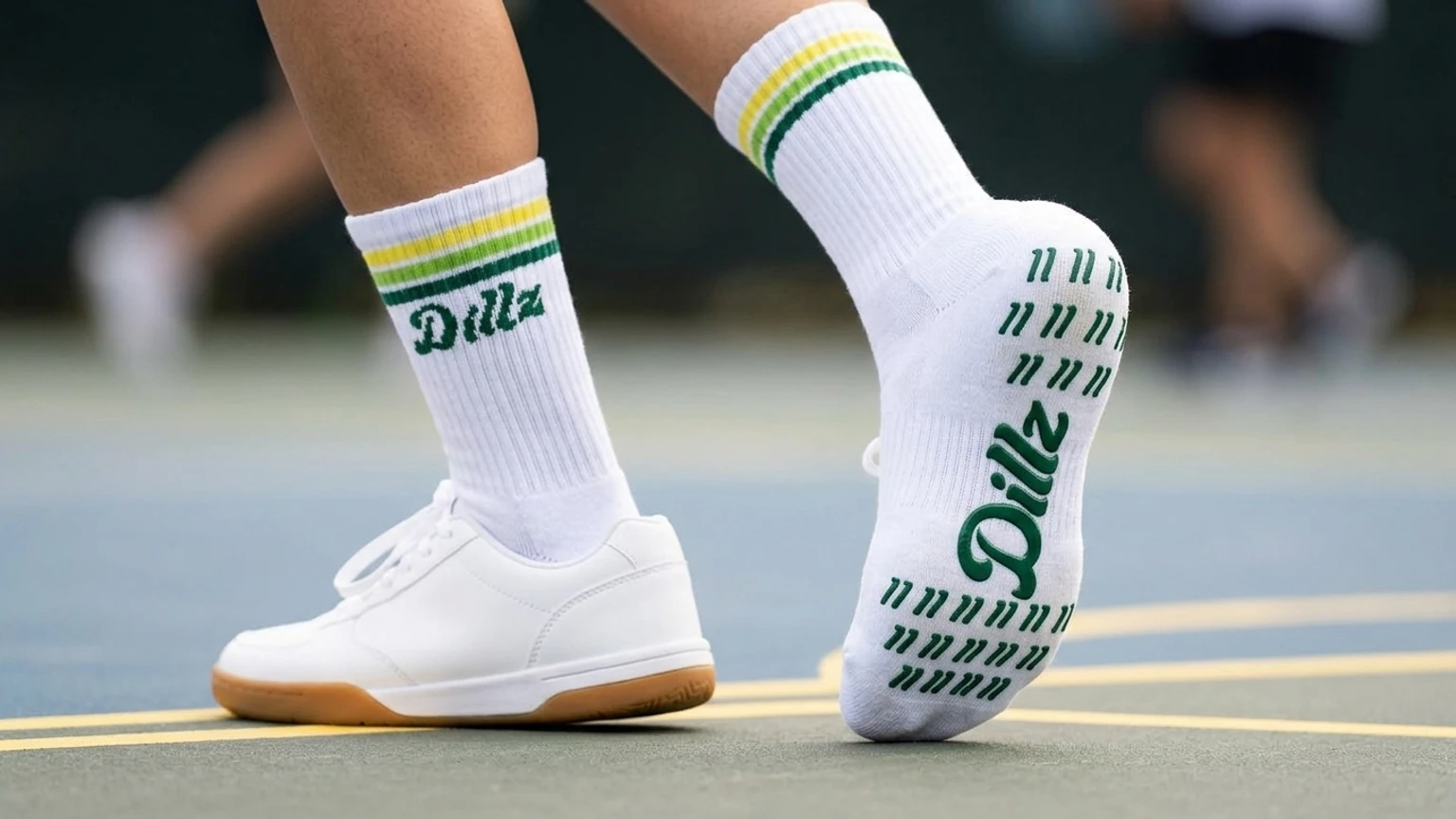
Dillz Grippy Grippy™ Crew and Ankle socks fit players who want more control inside a well-fitting court shoe during pickleball movement. Their approved court-sock features include full-sole grip, breathable comfort, targeted arch support, and a pickleball-first design for players who dislike foot or sock movement during play.
The choice between Crew and Ankle comes down to coverage and personal preference. Players who prefer more coverage can choose the Crew, while those who want a lower profile can compare the Ankle option with this guide to ankle grip socks for pickleball. Both styles should pass the same fit test: the arch support stays in place, the heel does not lift, and the shoe remains comfortable through lateral movement.
Dillz is one option among court-sock alternatives. Tavi emphasizes a compression arch band, Pointe Studio combines grip with compression arch support, and OS1st focuses more broadly on compression technology. Squidsocks is another alternative for buyers comparing grip-focused designs. Players who do not experience internal foot movement may prefer a regular court sock instead.
A Dillz 3-Pack can suit frequent players who rotate socks between practice, league sessions, and match days. Players comparing local and online sources can also use this guide to find grip socks near you or review where to buy grip socks.
How can you test the fit before your next match?
Test the socks with the shoes used for play. Start by walking on a hard surface, then perform a few split steps, lateral shuffles, controlled stops, and forward starts. These movements reveal bunching, pressure points, heel lift, and forward sliding more clearly than standing still.
Use this five-step check:
- Put the socks on without folding or stretching the arch band out of position.
- Lace the court shoes as you would for a match.
- Walk, split-step, and shift from side to side.
- Stop firmly and check for heel lift or forward sliding.
- Remove the shoes and inspect the sock for twisted fabric or pressure marks.
A successful fit feels settled rather than forceful. The arch band remains in place, the heel stays seated, and the full sole does not create a hot spot. The shoe should still feel spacious enough for the toes after several minutes of movement.
A clear contrast makes the decision easier. A good setup leaves the sock nearly unnoticed while the foot stays stable through a shuffle and stop. A poor setup creates immediate signals such as a pinched arch, compressed toes, heel rubbing, or continued sliding despite the grip.
Normal adaptation can involve noticing a new support band during the first few minutes. Pain, swelling, numbness, or discomfort that changes the way a player moves should not be played through. Reassess the sock size and shoe fit, then seek individualized clinical advice when the problem persists.
For players who have identified internal movement as the bottleneck, Dillz connects full-sole grip and targeted support to the demands of pickleball lateral movement. Shop grip socks.
Frequently Asked Questions
Do arch support socks really work?
They can help reduce unwanted sock and foot movement inside a properly fitted court shoe when the support band matches the player’s foot and the shoe has enough room. They are most relevant for in-shoe stability and comfort, not for diagnosing or treating an underlying foot problem.
What socks are best for arch support?
The best option has a secure mid-foot band, breathable construction, a stable heel and toe fit, and cushioning that does not crowd the shoe. For pickleball, full-sole grip is useful when the main complaint is movement inside the court shoe.
Is arch compression the same as compression socks?
No. Arch compression focuses pressure around the mid-foot, while compression socks can use broader zones across the foot and lower leg for circulation, swelling, recovery, or general support. The product’s intended use should guide the choice.
What kind of socks does a podiatrist recommend for plantar fasciitis?
There is no single sock that suits every case of plantar fasciitis. A podiatrist may recommend a comfortable, well-fitting sock or an arch sleeve as part of an individualized plan, but persistent pain should be evaluated clinically rather than treated as a sock-sizing issue.