Anti Blister Socks: How to Prevent Hot Spots on the Pickleball Court
Anti blister socks can reduce hot spots on court. Learn how to choose the right fit, grip, and moisture control for pickleball. Shop Dillz.
On this page
Anti-blister socks can reduce hot spots when they fit properly, manage moisture, and limit foot movement inside a court shoe. They cannot fix shoes that are too tight, too loose, or poorly shaped for your feet. For pickleball players, the right sock is part of a shoe, sock, and foot system that controls rubbing during split steps, quick stops, and lateral recovery.
What Are Anti-Blister Socks?
Anti-blister socks are designed to reduce the conditions that create hot spots: friction, moisture, heat, and fabric bunching. Repeated lateral movement can make your foot slide inside the shoe, while damp fabric increases rubbing against the skin. A loose cuff or bulky toe seam adds another source of irritation.
The wrong default is choosing a sock because its label says “anti-blister.” Grip texture, double-layer construction, or extra padding can help with a specific problem, but none proves universal blister prevention. The better approach is to identify where rubbing starts and match the sock construction to that issue.
Useful features include:
- Seamless or low-friction toe construction
- A cuff that stays in place without squeezing
- Breathable fibers and moisture management
- Targeted arch support
- Cushioning placed under the heel or forefoot
- A full-sole grip pattern to reduce movement inside the shoe
Cushioning alone does not prevent blisters. A thick sock can create more pressure if it crowds the shoe. Guidance from NHS Lanarkshire also warns that socks that are too small or have bulky seams can increase irritation and friction. Footwear advice from NHS Lanarkshire
The evidence also calls for realistic expectations. A 2017 systematic review covering 11 studies found limited high-quality evidence for sock-based blister prevention, while a 2024 assessment described evidence for double-sock systems as equivocal. 2017 systematic review 2024 critical assessment
How Blister-Prevention Socks Help on Court
A well-fitting pickleball sock can reduce foot sliding inside the shoe during quick starts, split steps, and lateral recovery. That internal movement matters because a sock that shifts with your foot can create repeated rubbing at the heel, toes, or forefoot.
Sock grip and court traction are separate systems. Sock grip works between the foot, sock, and shoe. Shoe traction depends on the outsole and the court surface. A grippy sock cannot replace a worn outsole or a shoe designed for court movement.
A 2022 team-sport study measured higher static friction with grip socks than regular socks, 1.17 compared with 0.60, and found reduced in-shoe forefoot displacement during braking. The grip-sock group also completed a slalom course faster, with a reported p-value of .001. The study did not test pickleball players or measure blister rates, so its results support reduced in-shoe movement rather than a proven blister outcome. Grip-sock biomechanics study
Consider a recreational player whose heel starts feeling warm halfway through a session. If the shoe fits well but the foot slides during recovery steps, a full-sole grip sock addresses a different part of the problem than thicker cushioning. If the sock is damp, changing into a dry pair may matter more. The American Academy of Dermatology recommends properly fitting shoes and nylon or moisture-wicking socks, with a second pair as an option if one pair does not help. American Academy of Dermatology blister guidance
View this post on Instagram
What to Look for in Socks for Pickleball and Tennis
Use this checklist before choosing a sock for court play:
| Recurring problem | Check first | Tradeoff or decision |
|---|---|---|
| Heel or toe rubbing | Shoe fit, sock size, toe seams, and moisture control | Fix the fit before adding thickness |
| Foot sliding inside a well-fitting shoe | Full-sole grip and sock thickness | More grip helps only if it does not crowd the shoe |
| Preference for fabric layers | Double-layer construction | The research evidence remains equivocal |
| Need for arch or studio support | Targeted compression and arch structure | Support does not automatically equal blister prevention |
Choose the height based on the shoe and the irritation site. Crew socks offer more coverage around the ankle and lower leg. Ankle socks suit players who prefer less material, provided the cuff stays secure and does not rub against the shoe collar.
Lightweight socks work well when the shoe already fits closely. Cushioned socks make more sense when the shoe has enough volume and the player needs protection under the heel or forefoot. A single-layer design keeps the fit simpler. Double-layer options, such as Wrightsock’s Escape Crew and Runderwear’s anti-blister running sock, are built around separating layers that move against each other, but vendor descriptions should not be treated as clinical proof.
Running and hiking socks can offer useful moisture control, cushioning, or toe construction. Court-specific grip socks add a different feature by limiting movement inside the shoe. Studio socks from Tavi and Pointe Studio emphasize full-sole grip for studio surfaces, while OS1st focuses on arch and heel compression. Compare the feature to the problem rather than assuming every grip or support feature serves the same purpose.
Are Grip Socks a Good Option for Blister-Prone Players?
Grip socks are worth considering when the feet or socks move inside properly fitting court shoes. They are less useful when the main problem is a shoe that pinches, a seam that hits the toes, or an existing blister that needs protection and time to heal.
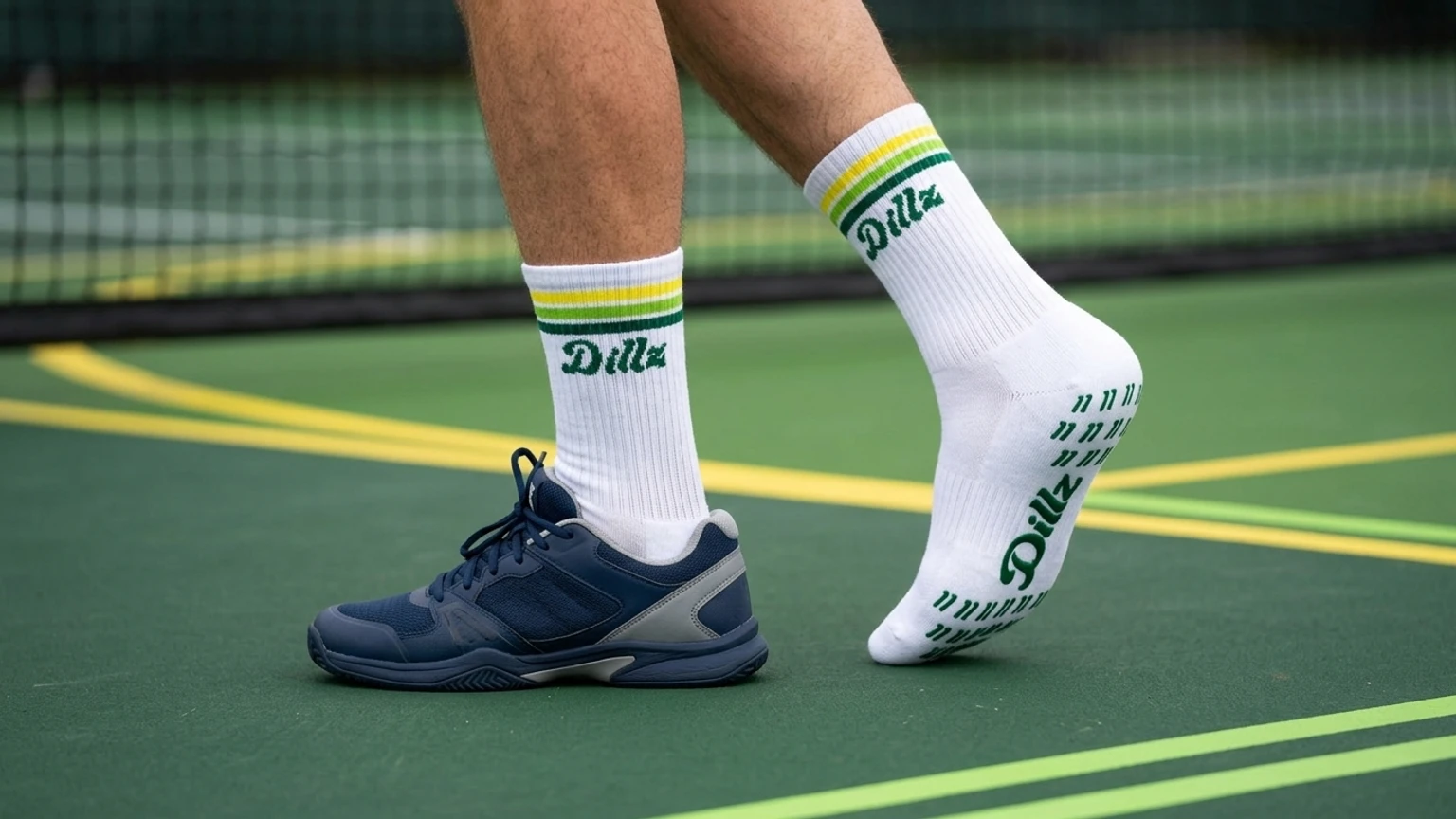
Dillz Grippy Grippy™ Crew and Ankle socks are designed for pickleball players who want full-sole grip inside court shoes, breathable comfort, and targeted ArchHug support. The Crew provides more coverage, while the Ankle offers a lower-cut option. Three-pack choices fit players who practice, play leagues, or spend several sessions on court each month.
Dillz describes its full-sole DillzGrip as intended to reduce unwanted sliding inside the shoe. That is a product-design claim, not evidence that the socks prevent pickleball blisters. Players should still check shoe volume, sock size, toe seams, and moisture before changing products.
A good decision process looks like this:
- Put on the shoes and socks you normally use.
- Walk, split step, and make lateral movements indoors.
- Mark the first location that feels warm, tight, damp, or mobile.
- Change one factor at a time, such as sock thickness, grip, or shoe fit.
- Stop immediately when pain, discomfort, or redness begins.
That final step matters. The AAD advises stopping activity when these warning signs appear, and the NHS recommends changing socks frequently when sweaty feet are contributing to the problem. NHS blister guidance
Players comparing Dillz with Tavi, Pointe Studio, OS1st, or squidsocks.ink should ask what they need most: court-focused in-shoe grip, studio traction, compression support, or a broader performance-sock design. For a player whose main bottleneck is unwanted movement inside a well-fitting pickleball shoe, Dillz offers a direct court-specific option.
When the sock, shoe, and foot fit work together, the next step is choosing the construction that matches your hot spot rather than chasing a universal winner. Players ready to compare the court-focused options can Shop grip socks.
Frequently Asked Questions
Do anti-blister socks actually work?
They can help when the recurring problem is moisture, fabric movement, seams, or foot sliding inside a properly fitting shoe. Research on socks remains limited, and the 2024 assessment found double-sock evidence equivocal, so no named sock should be treated as universally proven.
What socks are best for preventing blisters?
The best choice depends on the rubbing site. Look for a secure fit, low-friction toe construction, moisture management, suitable cushioning, and enough room inside the shoe. For court players with in-shoe movement, full-sole grip is another feature to compare.
What are the best socks for walking to avoid blisters?
Start with comfortable, well-fitting shoes and socks that manage moisture without bulky seams. The NHS recommends thick exercise socks such as moisture-wicking sports socks and changing socks when feet become sweaty, while the AAD recommends nylon or moisture-wicking options. NHS walking and blister guidance
How do you stop blisters while walking?
Check shoe fit, sock size, seams, and moisture before walking. At the first sign of pain, discomfort, or redness, stop and address the rubbing; a securely applied protective bandage can help with a known problem area. If a blister forms, protect it and avoid bursting it yourself. Seek medical advice for severe, recurring, or infected-looking blisters.