Pickleball Gear: How to Build a Court-Ready Setup
Build smarter pickleball gear with the right paddle, balls, court shoes, clothing, and grip socks. Use this checklist before you shop.
On this page
- What gear do you need for pickleball? Buy the essentials in the right order
- How should you match your setup to the court and your playing routine?
- Choose court shoes by separating two kinds of grip
- Use a problem-first filter for accessories
- Compare grip socks by fit, movement, and playing frequency
- What should you check before you spend? Build a purchase checklist
- Frequently Asked Questions
Pickleball gear works best when it matches the court, your movement, and how often you play. Start with a paddle, venue-appropriate balls, court shoes, and comfortable clothing, then add accessories only when they solve a specific problem such as sweat, storage, foot movement, or changing weather.
What gear do you need for pickleball? Buy the essentials in the right order
The right buying order keeps a new setup useful instead of expensive and cluttered.
- Choose a paddle. Pick a comfortable weight and handle size before worrying about advanced materials or specialty shapes. A paddle you can control through a full session matters more than a feature list.
- Match the balls to the venue. Indoor and outdoor pickleballs have different construction and flight characteristics. Confirm what your facility uses before buying a bulk pack.
- Choose court shoes. Look for shoes designed for lateral movement and stopping. Running shoes are built for forward motion, which does not match the repeated side-to-side demands of pickleball.
- Add comfortable clothing. Choose breathable tops, shorts, skirts, or pants that allow a full range of motion. A layer can help for early outdoor sessions or cool indoor facilities.
That list covers equipment needed to play. Accessories come later. A towel solves sweat, a bag solves organization, a hat helps with sun, and grip socks address unwanted movement inside a well-fitting shoe. Each earns space in your setup by solving a court-day problem.
For recreational players, buy the four essentials first and play several sessions before adding more. League players who play several times a month or more can justify duplicates of balls, clothing, and socks because laundry, weather, and back-to-back matches create practical demands. The complete pickleball equipment setup guide can help when a basic paddle-and-shoe setup needs to expand.
How should you match your setup to the court and your playing routine?
Your venue should determine more of your gear than a product advertisement does.
Indoor courts generally call for indoor balls, which are often softer and have larger holes than outdoor models. Outdoor balls are built for wind, rougher surfaces, and faster wear. Using the wrong ball can change the pace of play and create unnecessary frustration, especially when a facility has a preferred model.
Shoes also depend on the surface. Indoor court floors may reward a non-marking outsole and a clean, consistent contact pattern. Outdoor courts place more stress on durability and traction during hard stops. Players who move between venues may need one versatile pair or separate indoor and outdoor shoes, depending on how often each surface appears in the weekly routine.
A portable net, ball tube, court bag, or storage pouch becomes more useful when a player regularly visits public courts or carries equipment between locations. A player who uses a club’s net and leaves gear in a locker has less need for portable storage.
Tennis players already understand court shoes, paddles, and movement, but pickleball changes the spacing. The smaller court creates frequent split steps, short lateral adjustments, and transitions around the non-volley zone. Tennis shoes can work when their traction and fit suit the surface, as explained in this guide to tennis shoes for pickleball and tennis, but tennis players should test movement near the kitchen before assuming a familiar shoe feels the same.
Before buying duplicates or advanced accessories, answer three questions: Where do you play? How often do you play? What problem keeps showing up?
Choose court shoes by separating two kinds of grip
Court traction and sock grip solve different movement problems.
Shoe-to-court traction describes the outsole’s relationship with the playing surface. It helps the shoe resist unwanted sliding during stops, lateral movement, split steps, and quick changes of direction. The correct outsole depends on the court, so a shoe that feels secure on one surface may feel different on another. This is why a court shoe guide for pickleball should be part of the selection process before socks enter the discussion.
Sock grip works inside the shoe. Full-sole grip can help reduce movement between the foot, sock, and insole when the court shoe already fits well. It can make the shoe feel more settled during repeated movement, but it does not create outsole traction. It also cannot correct a shoe that is too large, too narrow, unstable, or uncomfortable.
Use this fit-check sequence:
- Check stability. Lace the shoe normally and make several side-to-side steps. Your heel should stay controlled without excessive pressure.
- Check comfort. Walk, split step, and bend through the knees. Look for pressure at the toes, arch, heel, or outside edge.
- Check natural movement. Your toes need room to spread and move without hitting the front of the shoe.
- Check the sock feel. Wear the sock you expect to use for a full court session. Notice whether the foot feels planted inside the shoe or whether the sock bunches, twists, or creates hot spots.
- Test after play. A shoe and sock combination can feel fine for ten minutes and uncomfortable after a longer session. Sweat, swelling, and repeated stops reveal problems that a quick fitting may miss.
A grip sock belongs in the final part of this process. The shoe remains responsible for contact with the court.
Use a problem-first filter for accessories
Accessories become easier to evaluate when each one answers a specific question.
- Sweat: A towel, moisture-managing shirt, or spare pair of socks helps when damp hands, feet, or clothing interrupt play. A player who finishes short recreational sessions comfortably may not need all three.
- Sun: A hat, sunglasses, sunscreen, and a light layer help on outdoor courts. A hat is especially useful when glare or heat affects concentration.
- Storage: A court bag or compartmentalized pouch earns its place when paddles, balls, clothing, and personal items travel together. Players who walk straight from the car to a club locker may prefer a smaller bag.
- Comfort: Grip socks, blister protection, and a dry change of clothing help when friction or foot movement repeatedly affects a session. The anti-blister sock guide for pickleball is useful when the issue is a hot spot rather than general sliding.
- Changing conditions: A lightweight layer, extra towel, and spare balls help outdoor players who deal with cool mornings, wind, or long court days.
- Repeated court days: League players benefit most from duplicates. A second shirt, spare socks, and backup balls are practical when one session leads directly into another.
A useful court-bag checklist includes one paddle, venue-appropriate balls, court shoes, a comfortable outfit, water, a towel, and one spare clothing item. Add a hat or grip socks only when they solve a known problem. This keeps pickleball gear focused on play rather than accumulation.
Compare grip socks by fit, movement, and playing frequency
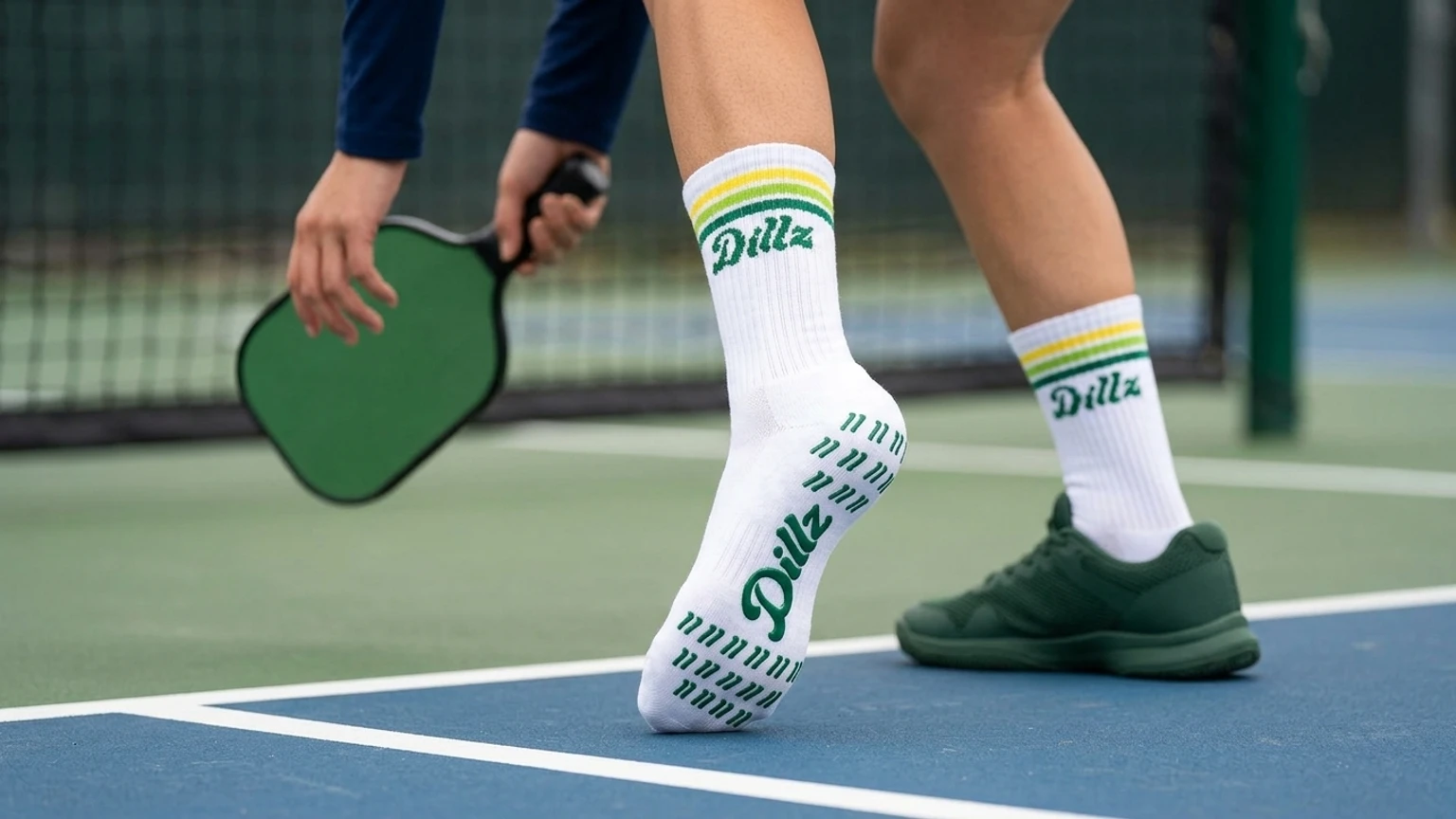
Grip socks deserve comparison by use case, not by a universal performance ranking. Dillz Grippy Grippy™ Crew and Ankle socks can be considered alongside Tavi, Pointe Studio, OS1st, and squidsocks.ink by checking the features that affect the player’s actual routine.
| What to compare | Why it matters on court | Best fit for |
|---|---|---|
| Full-sole grip | Helps reduce foot or sock movement inside a well-fitting shoe across more of the foot | Players who feel internal movement during stops or lateral transitions |
| Breathable comfort | Helps the sock remain comfortable as the session gets longer and warmer | Players who play full sessions or outdoor matches |
| Targeted arch support | Adds structure around the arch without changing the shoe’s outsole traction | Players who prefer a more supported sock feel |
| Crew or ankle height | Changes coverage, personal preference, and compatibility with shoe collars | Players choosing between more coverage and a lower profile |
| Shoe compatibility | Determines whether the sock fits smoothly inside the chosen court shoe | Anyone with a close-fitting or narrow shoe |
| Multipack value | Makes rotation and laundry easier for frequent players | League players or anyone playing several times a month or more |
Dillz positions its Grippy Grippy™ Crew and Ankle socks for pickleball players who feel unwanted movement inside a well-fitting court shoe. The full-sole grip is paired with breathable comfort and targeted arch support, while the two heights let players choose based on shoe collar and coverage preference.
A three-pack makes practical sense for frequent players who rotate socks between court days. Recreational players with a less demanding schedule may prefer a single pair first, especially when they are still determining whether internal movement is a real problem.
Regular court socks remain a sensible choice for players whose feet already feel stable inside their shoes. Grip socks address a specific comfort and movement concern. They are not required equipment for every player.
What should you check before you spend? Build a purchase checklist
Use this quick filter before adding anything to your cart.
Keep
Keep gear that fits the venue and feels comfortable through a typical session. That includes a controllable paddle, the correct indoor or outdoor balls, court shoes with suitable traction, and clothing that allows unrestricted movement.
Replace
Replace gear that creates a repeatable problem. Swap shoes that slide, pinch, or lack lateral support. Replace balls that are damaged or poorly suited to the surface. Replace clothing that restricts your swing or becomes uncomfortably heavy with sweat. If your feet move inside a properly fitted shoe, test a different sock system before changing the shoe itself.
Skip
Skip accessories that solve no real court-day problem. A second bag, specialty organizer, or duplicate gadget does not improve a setup simply because it appears in a gear list. Buy for the conditions you actually face.
The final checklist is simple:
- Paddle you can control comfortably
- Balls suited to the venue
- Court shoes with appropriate traction
- Clothing that supports free movement
- Water and a towel when needed
- Spare socks or clothing for longer sessions
- Grip socks only if internal foot or sock movement affects comfort
Dillz Grippy Grippy™ socks fit the last category. They make sense when the shoe is right but the foot still feels unsettled inside it. Players comparing heights can also review this guide to ankle grip socks for pickleball, while players focused on internal movement can read about what non-slip socks actually do inside a pickleball shoe.
Once the paddle, balls, shoes, and clothing are matched to the court, the next decision should come from the problem you still feel during play. For players who want a more settled sock feel inside a well-fitting court shoe, Shop grip socks.
Frequently Asked Questions
What is the best brand of pickleball gear?
There is no single best brand for every player because paddles, balls, shoes, clothing, and socks solve different problems. The best choice is the brand whose product matches the venue, fits comfortably, and holds up to the player’s routine. Compare the specific item and use case instead of choosing one brand for the entire setup.
What gear do you need for pickleball?
You need a paddle, pickleballs suited to the playing venue, court shoes with appropriate traction, and comfortable clothing. A net is also necessary when the court does not provide one. Bags, towels, hats, spare clothing, and grip socks are optional accessories tied to specific comfort, weather, storage, or repeated-play needs.
What is replacing pickleball?
No single sport has replaced pickleball. Padel is often discussed alongside pickleball as another growing racket sport, while tennis, platform tennis, and other court activities remain active choices. Current participation reporting continues to describe pickleball as a growing sport in the United States, so the more useful question is which court sport fits a player’s preferred movement, venue, and social routine. (sfia.org)
What is the 10 second rule in pickleball?
The 10-second rule refers to the serving team’s responsibility to be ready after the score is called. Under the 2025 USA Pickleball rulebook, the server must serve within the applicable ten-second count, with rule details covering readiness and delays. Rules can change between editions, so league and tournament players should check the current USA Pickleball rulebook for the version governing their match. (usapickleball.org)