Pickleball Clothing: How to Build a Court-Ready Outfit from Socks to Shoes
Build better pickleball clothing from socks to shoes. Use this court-ready outfit guide to choose grip, fit, coverage, and layers.
On this page
- What to Wear for Pickleball: Start with the Full Court Interface
- Build a Pickleball Outfit Around Movement, Weather, and Coverage
- Choose Sock Height and Grip Coverage Before You Choose a Match
- Match Breathable Apparel with a Stable Court-Shoe Setup
- Use Sweat Management and Support as Clothing Buying Criteria
- Three Court-Ready Outfit Formulas for Different Players
- Frequently Asked Questions
- Continue this guide
Breathable, unrestricted layers are the starting point for pickleball clothing, but a court-ready outfit also depends on sock height, grip coverage, arch support, sweat management, and shoe fit. Treat the clothing, socks, and court shoes as one movement system so quick stops and lateral exchanges feel settled from the ground up.
What to Wear for Pickleball: Start with the Full Court Interface
The common mistake is treating pickleball like a general gym workout. A loose shirt and running shorts may feel comfortable during warmups, yet quick split steps, lateral cuts, deep lunges, and kitchen-line exchanges reveal whether the outfit actually supports play.
Build the setup in this order:
- Choose a top that allows full shoulder and torso movement.
- Choose bottoms that stay secure during lunges and reaches.
- Match sock height to the shoe collar, climate, and coverage preference.
- Use socks that lie flat and help the foot feel stable inside a well-fitting court shoe.
- Finish with court shoes designed for the playing surface.
This approach separates looking ready from feeling settled. A polished matching set does not compensate for a shoe that lets the heel move or a sock that bunches under the arch. Players comparing non-skid socks for indoor pickleball should consider the entire interface, including the court surface, shoe construction, and type of movement.
The operating rule is simple: build from the court surface upward, then choose clothing around the way you actually move. That rule works for recreational games, league matches, tennis, and padel because each activity still demands coordinated movement, coverage, and footwear.
Build a Pickleball Outfit Around Movement, Weather, and Coverage
Good pickleball clothing gives the player room to move while keeping coverage and storage predictable. Tops should allow a full arm swing without pulling across the shoulders. Shorts need a waistband that stays in place. Skorts, skirts, and dresses work best when built-in shorts provide reliable coverage during lunges and reaches.
A skort can combine several useful features in one garment. RBX Active describes a pickleball skort with built-in shorts, pockets, and quick-drying fabric for court use. In a practical review of a built-in-short skort, Tiffany Ann C’s skort demonstration also focuses on coverage, pocket placement, length, and comfort during pickleball or tennis.
The right silhouette depends on the player:
| Clothing choice | Check before buying | Best fit for |
|---|---|---|
| Shorts | Secure waistband and enough reach coverage | Players who prefer maximum leg freedom |
| Built-in-short skort | Short liner, useful pockets, stable hem | Players who want coverage with a skirt silhouette |
| Dress | Secure liner and unrestricted hip movement | Players who prefer one-piece outfits |
| Pants or light layer | Full knee and hip bend without excess fabric | Cool courts, warmups, and changing conditions |
Recreational players may want an outfit that moves from court to errands. League players often value secure pockets, removable layers, and a polished look between matches. Tennis and padel players can apply the same checks, but the court shoe and movement demands should still guide the final choice.
Choose Sock Height and Grip Coverage Before You Choose a Match
Crew and ankle socks create different coverage and collar-feel experiences. Crew socks cover more of the lower leg and can feel more familiar around a higher shoe collar. Ankle socks expose more of the leg and often suit warm conditions or low-cut court shoes. Neither height wins universally. The decision follows climate, shoe shape, personal preference, and whether the sock stays flat during movement.
Grip inside the sock serves a different purpose from traction beneath the shoe. Sock grip is intended to reduce unwanted foot or sock movement inside a well-fitting court shoe. The outsole remains responsible for contact with the court surface. A full-sole grip sock cannot replace a court shoe with an outsole suited to lateral movement.
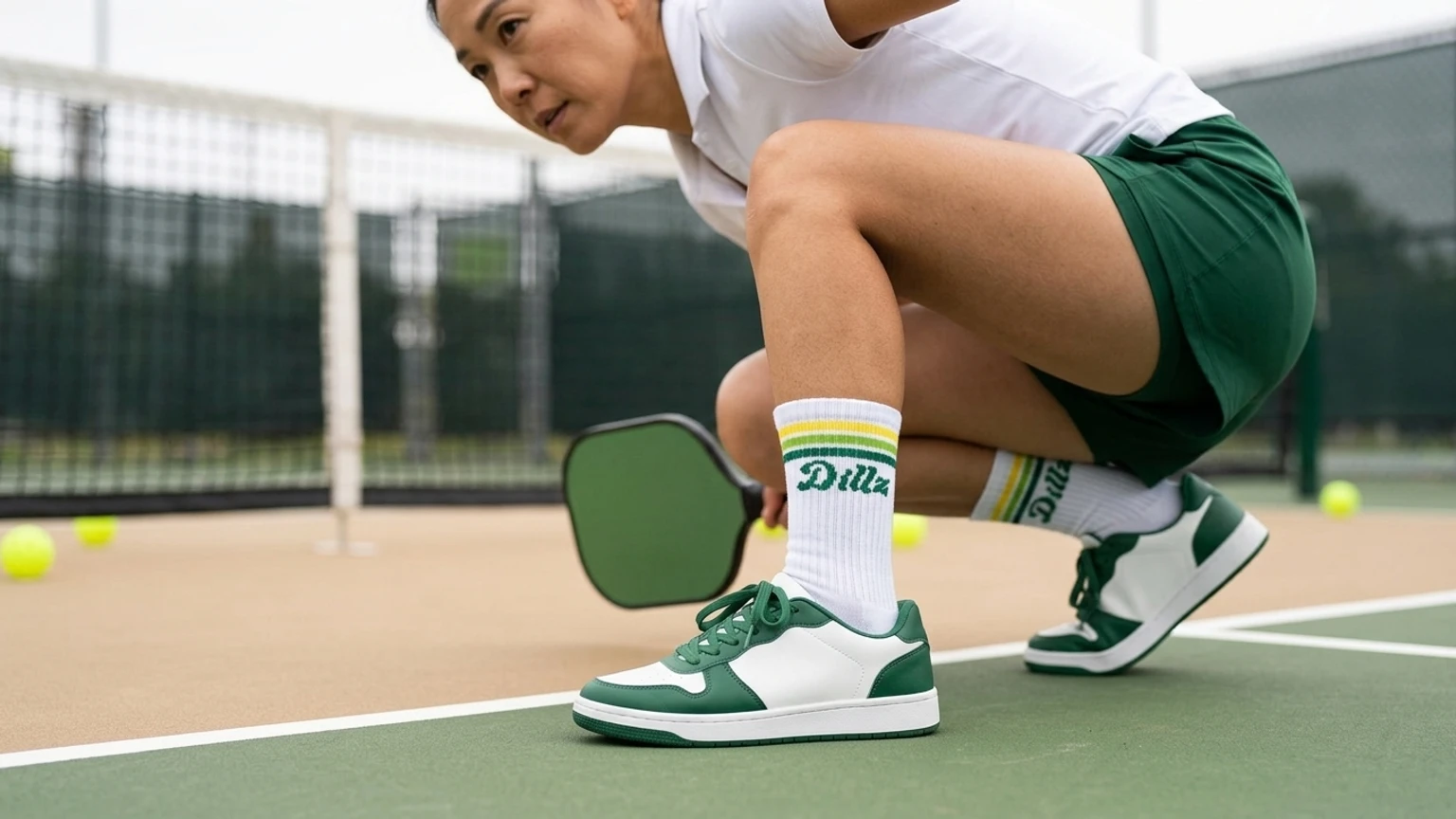
Dillz Grippy Grippy Crew socks give players a pickleball-first crew option with full-sole grip, breathable comfort, and targeted arch support. Dillz Grippy Grippy Ankle socks provide ankle-height coverage, breathable material, and arch compression. Both options suit players comparing regular court socks with a grip-focused design and a coastal court style.
Use this manual test before deciding:
- Put on the sock and court shoe together.
- Walk through a split step.
- Perform a lateral shuffle in both directions.
- Add a deep lunge and a quick stop.
- Remove the setup if the sock bunches, the collar rubs, or the foot still slides excessively.
For players who prefer less lower-leg coverage, ankle grip socks for pickleball provide a focused comparison. The deciding factor is how the height works with the shoe and movement, rather than how the sock looks in a product photo.
Match Breathable Apparel with a Stable Court-Shoe Setup
Court shoes and running shoes solve different movement problems. Pickleball court shoes are designed for hard-court play with features such as lateral support, non-marking soles, and mid-shank stability, according to Pickleball Central’s court-shoe guide. Tennis court shoes use similar principles, including tread patterns, reinforced rubber in high-wear areas, and support for quick lateral movement, as described by Tennis Warehouse’s all-court shoe guide.
PickleballCentral also explains in its court-shoe video that running-shoe outsoles are built for a different movement pattern. Running shoes can feel cushioned while offering a less suitable platform for repeated side-to-side cuts on a hard court.
Use this fit check before blaming the sock:
- The toes should have room without the foot sliding forward.
- The heel should stay seated during a lateral shuffle.
- The shoe should hold the foot without uncomfortable compression.
- The sock should lie flat through the heel, arch, and forefoot.
- The outsole should match the court surface and intended use.
A good setup has a flat sock inside a secure shoe, with the foot staying settled during a shuffle and lunge. A poor setup has a loose shoe, a bunched sock, and grip coverage being asked to correct movement caused by the footwear. Replace the poor shoe fit first. Then decide whether a grip sock improves the remaining interface.
Use Sweat Management and Support as Clothing Buying Criteria
Comfort becomes easier to evaluate when it becomes a shopping checklist. Look for breathable fabric, manageable moisture, smooth seams, secure waistbands, practical pockets, and layers that can be removed as the body warms. Outdoor players should also account for sun and wind, while indoor players may prefer lighter layers that do not restrict shoulder movement.
Sweat changes how the sock and shoe feel over the course of a match. A damp sock can become more distracting when the foot repeatedly stops, pivots, and changes direction. Players who develop hot spots should review anti-blister socks for pickleball before changing their entire outfit.
Arch support and a stable-feeling sock are most relevant when the player notices movement inside an otherwise well-fitting shoe. Dillz is one option for that comparison. Its Grippy Grippy Crew and Ankle designs give players different heights and support approaches, while regular court socks may remain the better choice for players who already feel secure.
Other products serve different priorities. Tavi describes double-grip technology and moisture-wicking on its Tavi Tec performance sock page. OS1st focuses its pickleball sock collection on lateral movement, breathability, and impact protection. Pointe Studio’s full-foot grip collection is designed for Pilates, barre, and yoga, while Squidsocks markets grip zones for pickleball, tennis, and other court sports.
Frequent players can also consider Dillz three-pack options when building a rotation of crew or ankle socks. The useful stop condition is simple: if the sock creates pressure, bunching, or heat that distracts from play, choose a different height or construction.
Three Court-Ready Outfit Formulas for Different Players
These formulas connect clothing, socks, and shoes without treating one silhouette as correct for everyone.
Warm-weather recreational set
Choose a breathable tank or short-sleeve top with secure shorts or a built-in-short skort. Pair the outfit with ankle socks when the shoe has a low collar and the player prefers less coverage. Finish with court shoes suited to the surface. The result stays light while preserving coverage during lunges.
League-day layered outfit
Start with a breathable top, performance shorts or a pocketed skort, and crew socks for more coverage around the shoe collar. Add a removable warmup layer for time between matches. This setup suits players who move between waiting areas, warmups, and competition while keeping essentials close.
Cooler-court outfit
Use a breathable base layer beneath a lightweight long-sleeve top, then choose flexible pants that allow a full bend at the knees and hips. Crew socks can provide a more covered feel inside the shoe. Keep the outer layer easy to remove once the body warms up.
A matching set can satisfy style goals when it also passes four checks: movement, coverage, sweat management, and footwear compatibility. An interview with Parris Todd emphasizes the value of quality construction, fit, and design in pickleball apparel through Pickleballdotcom’s fashion interview. Appearance still needs to be tested against actual movement.
Before buying, check the top, waistband, pockets, sock height, shoe fit, and fabric weight. If the outfit works but the foot still moves inside the shoe, compare a Dillz Grippy Grippy Crew or Ankle sock with the current court-sock setup. Athletic grip socks for pickleball offer another useful comparison before making that change.
When the clothing fits the movement and the sock-to-shoe interface feels settled, Dillz gives players a pickleball-first grip sock option to compare by height, coverage, and support. Shop grip socks.
Frequently Asked Questions
What is an appropriate pickleball attire?
Appropriate pickleball attire includes breathable tops, secure shorts, skorts, dresses, skirts, or flexible pants that allow unrestricted lateral movement. Pair the clothing with socks that stay flat inside a well-fitting court shoe and footwear designed for the playing surface.
What is the best pickleball clothing brand?
There is no single best brand for every player because fit, coverage, climate, and style preferences differ. The strongest choice provides comfortable movement, secure coverage, useful pockets, and compatibility with court shoes. Dillz focuses on the sock-to-shoe part of the outfit, while apparel brands offer different tops, bottoms, layers, and silhouettes.
What are some good pickleball outfit ideas?
A warm-weather outfit can combine a breathable top, shorts or a built-in-short skort, ankle socks, and court shoes. A league-day outfit can use a matching top and bottom, crew socks, secure pockets, and a removable layer. Cooler conditions call for a breathable base layer, flexible pants, crew socks, and an easy-to-remove outer layer.
What is the best dress to wear when playing pickleball?
The best dress has built-in shorts, secure coverage, useful pockets, and enough room for lunges and lateral movement. Test the dress with a squat, lunge, reach, and quick side step before wearing it for a full match. A stylish design works when the liner, waistband, and shoe interface remain comfortable during play.